Hand Filling.

When I worked on the coal face I started out hand filling . The faces
varied in length, but the procedure was pretty much the same.
A coal cutting
machine would undercut the coal before we arrived on the face. The duff
or gumming (the thick coal dust from the undercut) was left in a small
area between the coal face and a bottom loading conveyor belt.
The coal
seam thickness was little more than two foot in height (some other faces
were higher) and perhaps 100 yards long.
Holes had previously been drilled
along the length of the coal face. The next step was to blast the coal
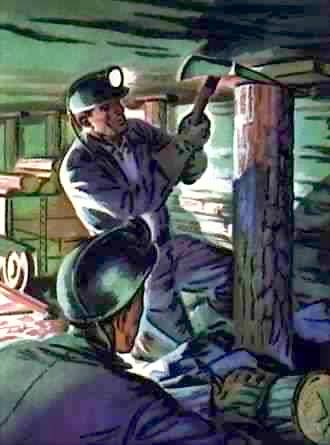
with explosives, hand fill the coal onto the conveyor belt, then set supports
where the coal had been removed.
As you can imagine there was limited height
and when you first went on the face, you had to take your tools with you.
There was a shovel, to fill the coal with, a saw, to cut the timber, a
long handled hammer, to knock the timber into position, and a tin, with
the explosive powder in.
If you were lucky your stint (place of work) was
near the entrance to the face.
If you were not so lucky you had to drag
yourself and your equipment to the middle of the face.
A story often told
by the colliers (miners), perhaps tongue in cheek, was that they crawled
all the way to their stint, found they had taken their shovel on the coal
face wrong way round, and had to turn, crawl all the way back, off the
face, to turn their shovel, because it was so low on the coal face they
couldn't turn the shovel there.
" I was shattered before I started ",they
would cry.
Although this may be an exaggeration it gives a little insight
into coal mining.

|